
By George B. McGuinness, Whitworth University
Instructions for Reading “The Cage”
Opening Remarks
BEFORE CONTINUING! If you have not already, read the historical and narrative context primer “A Few Thoughts about The Cage”.
For those with little or no experience in reading music, general explanations for standard musical symbols found in the work will be given.
The piece begins in the upper left corner and ends in the lower right corner at the black dot.
The piece might be attempted to be played aloud, but it is not intended to be or required to be played aloud. Rather, while reading along, performers/readers are meant to internally hear what they imagine the piece would sound like.
Symbols Explanation
While this piece uses notation that is commonly used in standard Western musical notation, not all features of that style of notation are present. Concepts such as time signatures, clefs, accidentals, etc. are not used in this work as they were not seen to be necessary for the aims of this work. If readers wish to explore more about notation and more generally about reading music, they should know that this is not an exhaustive example of traditional western music notation.
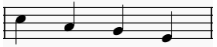 | The image is what is called a bar or measure of music, and these act as sort of containers of sonic events in Western music notation, with most of these sonic events usually being pitches to be played by some instrument. The five horizontal lines with two vertical lines is the bar or measure itself. The black dots or notes as they are called would be the pitches played by a performer. The placement of the notes on the bar or measure determines the pitch and distinguishes notes from one another. A bar or measure is usually read from left to right but in this piece can also be read from right to left. Note: While the notes in this piece may be interpreted as traditional pitches, they can also be interpreted as singular sound events, such as the clang of metal or a dog bark. |
 | In this piece, these arrows allow the reader/performer to jump between bars of music which are not right next to another. If the performer/reader chooses to use these arrows, they must follow the direction of the arrow. |
 | This symbol is called a fermata. In traditional western music notation, the fermata indicates to the performer(s) to take a long pause before returning to playing the music. |
 | This symbol is a called a breath mark. As compared to the fermata, it indicates to the performer(s) to take a shorter pause in the music, often for the sake of wind instrumentalist or singers in need of taking a breath. |
 | This symbol is called a decrescendo. It indicates to the performer(s) to gradually decrease the volume of the music being played. |
Performance Instructions
For most bars of the piece, bars can only be repeated three times.
However, if the performer follows the few arrows in the score, these arrows allow the performer to play the bars to which these arrows are directed as many times as the performer wishes.
When reading/playing a bar, the performer may read the bar from left to right or right to left.
For the notes in each bar, the performer must choose a corresponding sound for each note that must be the same across all iterations of the same note across every bar of the piece. The corresponding sound could be anything the performer chooses. However, the length of the sounds and distance between sounds within bars is free for the performer to choose and can vary between bars.
When finishing the reading/performing of a bar the performer may either repeat the bar or move on to any adjacent panels.
The physical appearance of the score has just as much relation to the sound as does the notes. You might want to consider the distance between, angles of, and appearance of bars in this work. While the text on the score may not be explicitly musical, the text should also factor into your performance of the piece.
The Cage

The Recordings
Included with the piece are two interpretations of the work, one made electronically by myself by recording my voice, the scratching of metal, the strumming of an out of tune banjo, and the shaking of a metal cup with a coin inside it. All these recordings were manipulated and then sequenced together to form one possibility for the work. The other interpretation is a recording of my lovely girlfriend Anna performing the piece on her cello. These are not definitive interpretations of the work and merely stand as examples of what is possible with an audible interpretation of The Cage.
Software Used: Microsoft Word, Microsoft Paint, and Musescore
REFLECTIONS
Student Reflection: George B. McGuinness
Instructor Reflection: Fred Johnson
OTHER DOCUMENTS
Assignment
Rubric
 JUMP+
JUMP+ 